
By: Riley Glover
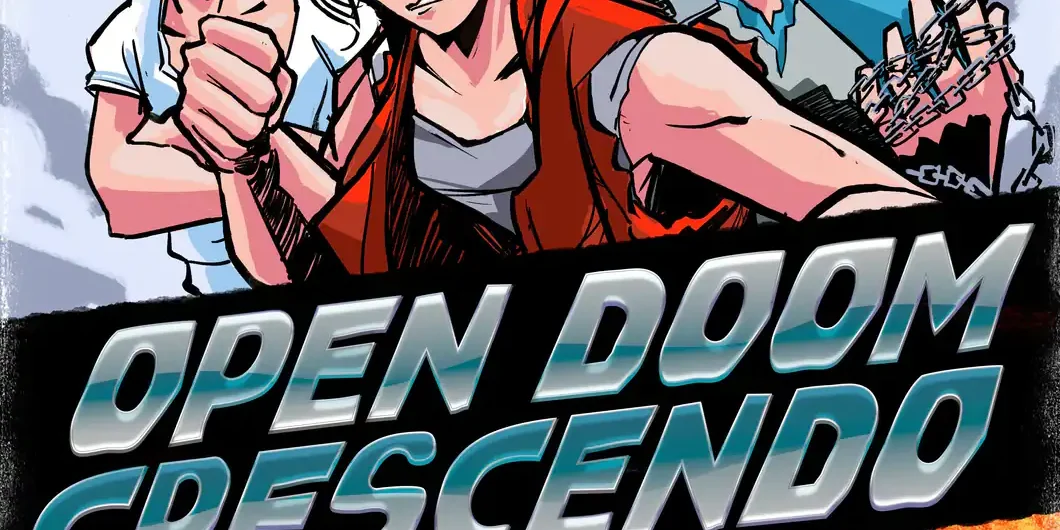
Describing “Open Doom Crescendo” as a film for normal people to watch is a near impossible endeavor in concept; because you will likely never have the time or effort to see such a thing. It is a three hour long micro budget movie that has spent the last two to three years constantly touring the Indie Film Festival circuit, with less than 1000 Blu-ray copies running around the world, one of which I own myself. Outside of contacting writer/director/editor/composer Terry Chiu directly, don’t expect to see this film any time soon on a streaming service or rental even if you have the patience for a three-hour long movie that quite literally looks like it was shot in a backyard.
But it is one of the most important films released this century.
Understanding “Open Doom Crescendo” as a movie requires going way beyond a basic plot description, to which this already has a doozy of a description. In a dimensional plane fragmented from our own that looks suspiciously like the undeveloped land outside of a gentrified Montreal neighborhood, two people named Keikei and Rev are trying to find their missing friend during a strange battle royale/Mad Max scenario where everyone there is also trying to cure their existential angst by finding the literal Embodiment of Angst or get killed trying. Or they just mope around in their weird little gangs, rambling about complex philosophies to life in relation to angst.
One of the key inspirations for the stylistic tone of this movie was “Neon Genesis Evangelion.” An anime which infamously turned from a postmodern deconstruction of Mecca anime into lead creator Hideaki Anno’s depression fueled existentialist meltdown. Eventually, the alternate ending film “End of Evangelion” showed hostile metatextual criticism of the Japanese Otaku nerd community. Anno had a major influence on “Open Doom Crescendo,” which takes the metatextual nerd existentialism to even further extremes Hideaki would never even try because of how deliriously alienating it is in a realistic sense.
Large swaths of scenes are extended dialogues, written like both the most insane parts of Tumblr and 4Chan millennial nerd culture colliding into almost jazz-like philosophical mania. People will say stuff like “I’ll welcome the site anew of dead shrubs, while karate-chopping generations of burs to Heaven which is the real Hell” half the time, all of it being subtitled in both English and Cantonese with dense visual jokes added in. There are frequent stylistic changes into meditative cinema, absurdist action comedy, and metatextual conversations about the painful seven-year development of the film itself. The episodic structure of the film itself blows it out to include other strange characters like “The Gertrude,” a severely depressed deformed creature who begins hopping in and out of the story, or “Psycho in the Radio,” a person running around in pants modified into a bra and a robot that’s a giant rectangular tin box that can spawn things to crush people with.
I can keep going on with this because the level of weirdness is difficult to uphold at times because it’s difficult to rationalize such a work. It took me over a week to watch the thing through careful study and reading through numerous interviews to feel any coherent idea because finding catharsis from the concept of angst is an inherently absurdist position because there is no one clear answer.
For myself, it’s very clear that Terry is working through a lot of issues as an Asian dysphoric Canadian with the film’s usage of multiple languages. The cynicism it has towards white consumption and gentrification of Asian culture through its barren wasteland, telling character beats, and dialogue sequences take Otaku criticisms into outright assaults against cultural appropriation. Even how one tries to find their identity within false binaries like the direct influence of Japanese art despite cynicism towards the history of Japanese imperialism bleeds into the weirdness of the film’s concept.
It’s a movie that was clearly made with only $1000 and looks like a home movie yet explodes with passion regarding the thematic ideas it wants to tackle, ruining the idea that a low budget film must be limited in scale. It’s stylistically indebted to film makers like Zack Snyder and James Wan, yet somehow becomes the closest we’ll get to a 21st century “Waiting for Godot” in its usage of wandering absurdism and unfinished existential pondering over greater concepts we can never reach.
For Terry, he tries to answer an unanswerable question using a cinematic language that’s mostly noted for clear-cut answers, only to go beyond his avant-garde comparison points of Hideaki Anno into an aesthetic criticism against any preconceived notions of what art can be within a late-stage capitalist, white supremacist western society and turning film into a meditative, collectivist art against any preconceived notions of duality, clarity, and scale.
By the end, I can’t give you a clear answer of what the film is about in relation to angst because such an emotion is deeply personal and one can only give subjective perspectives on how to get through that, but the ability to talk about these issues honestly and create new solutions around them is perhaps more important right now than any time ever.
From the very beginning, Terry dares the viewers who aren’t outsiders like him and are hostile to the film not to feel anything during the runtime, almost as a game of chicken. I can say with confidence he has succeeded in making me feel more than 99% of other movies right now, even if unfortunately, 99% of people will skip the film due to the sheer audacity of such unreal, unfettered emotional power.