
By Riley Glover
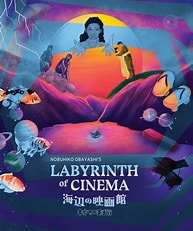
There’s a sequence towards the end of 2019’s “Labyrinth of Cinema” that has broken my heart both times I’ve seen it and it’s the most visually simplistic sequence. It is a list of names, dates, and ages read by a narrator for nearly a minute, noting the deaths of the Sakura acting troupe caused by the Hiroshima bombing, first by the blast and then by long-term radiation poisoning. It’s the one sequence I reference the most, and why I have called Nobuhiko Obayashi’s final magnum opus the greatest film ever made.
So, listen, “Labyrinth of Cinema” is a weird film because I could describe the film like this: a trio of kids have become unstuck in time. Film freak, Mario Baba, film historian freak, Hosuke, and an initially unnamed Monk turned wanna-be Yakuza have been consumed into the world of film on the last operating day of a theatre doing an old war film marathon. The trio is chasing a young girl named Noriko (hope in Japanese) who has been sucked into these films, with the films representing moments in time from the 1860’s to the 1940’s emphasizing the rise and fall of Imperial Japan.
There is also an alien named Fanta G, who introduces the film’s setting by speaking about the history of humanity’s capability for violence while a goldfish swims around and pianos fly outside his spaceship. He and his daughter overall play roles as narrators, providing perspective on the real history of both Japan and Art as it intertwines with the kids’ adventure. This adds a Brechtian atmosphere for the audience to be more interactive with how society creates war and questions it.
The film is structured around readings of poet Chūya Nakahara, whose modernist if not dadaist poetry speaks to a barbarism in modernism he was feeling in the air and, despite his 1937 death, seems to almost predict the waltz into hell Japan’s government would lead its people into by 1945 and into the modern age born from the rotten spoils of war.
“Labyrinth of Cinema” is doing a lot, without any serious conversation. The film quickly becomes about director, co-writer, producer, and editor Nobuhiko Obayashi himself, who designed it to be his final artistic statement while battling cancer.
Born in 1938 in Onomichi, within the Hiroshima Prefecture, Obayashi grew up during a time of imperial fascism and death were forced onto his generation by adults and the government. He describes in an interview in Mubi Notebook an old man he knew as a child saying he would mercilessly kill Obayashi if Japan lost only for that same man screaming “Peace!” once the war was over.
His mainstream 1977 debut film “House” is a good example of these strange contrasts. Famously known as his surreal horror comedy made with the ideas his then pre-teen daughter, the film was a thematic re-write of his first attempt at “Hanagatami.” Obayashi admitted in the Mubi interview that he took character ideas from the coming-of-age drama “Hanagatami,” and projected them into the safety of genre and in a weird way.
Obayashi’s career overall is extremely dense to speak about; he directed over 50 films and allegedly over 3,000 commercials.
While researching “Labyrinth of Cinema,” I discovered that the “Mario Baba” character goes back to an obscure 1999 film called “The Stupid Teacher.” That seemed to be a deeply autobiographical work about Obayashi’s childhood. the film’s child flashback sequences were incorporated into “Labyrinth of Cinema” and the director hired that same grown-up child actor for the role. This film is still untranslated in English.
However, the March 11, 2011 Tōhoku earthquake and following tsunami reawaken something important for Obayashi, the last decade of his career was entirely dedicated to a massive stylistic and aesthetic change focused upon dense 3-hour long melodramas that disregarded many of the most basic rules of mainstream filmmaking and brought new international attention. Starting with “Casting Blossoms to the Sky” onward, most of his films seemingly took place on deliberately artificial green screen backgrounds with dense effects to reference the blurring line of reality and fiction; conversations between characters about their feelings quickly escalate into dense fourth wall breaking ramblings about the connections art, trauma, geography, and war have with each other. Sometimes the same conversations bleed into multiple films; the editing and cinematography have the movement of a hyperactive child yet still contains a mature POV towards the subjects and locations.
“Labyrinth of Cinema” then becomes a heartbreaking final project with the context of his cancer diagnosis. His penultimate film was “Hanagatami,” with the diagnosis fresh on the mind; he ended the film with essentially a direct challenge to the viewer to jump beyond Obayashi himself.
Once the manic opening 75 minutes pass by, exploring the trio trying to save Noriko throughout the history of Japan moving into the imperial age by using film’s evolution into sound and color as contrast, a seemingly random intermission triggers a subtle yet important tone shift that lasts until the end. As the editing is less ‘complete assault on the senses’ and more ‘caffeinated bender. While the trio goes through different types of films about the war and frequently interrupts the plot with historical and personal diatribes, one questions if Obayashi has finally ‘jumped’ in a sense. Despite the dense cross media references to his other work, “Labyrinth of Cinema” works is almost a perfect introduction to the man in the same way “Slaughterhouse-5” is to Kurt Vonnegut, where the artist lays out in articulate detail through both auto fiction and genre the personal philosophical beliefs that guided all of their work and their want of a better world from it.
There’s then no way one could watch “House” after “Labyrinth of Cinema” and not see the trauma of the war haunt over the film the same way one can never forget “Slaughterhouse-5’s” Dresden bombing and its oblique reference in the earlier “Cat’s Cradle.” For artists like these, spending large chunks of their lives articulating why these past nightmares haunt them still, Obayashi verbalizes though two connected thoughts why; film and artistry cannot change the past despite our attempts, with film then becoming an elaborate lie in how it warps reality to clean genre tropes. However, film can still be used to energize, encourage, and inform change away from conservative forms of authority and thinking if the artist takes the responsibilities of being both the co-creator and cheerleader of the new world.
“Labryrinth of Cinema” encapsulates both heartache and hope. It represents one of the final significant artistic contributions regarding World War II from someone who lived through that era. With that said, it serves as a memorial for the first century of cinema, reflecting its shortcomings while advocating for its future significance.
That’s why I consider this film the greatest ever made even if it’s not always my favorite. By the film’s conclusion, it successfully argues the need to become a better person and artistic growth. It beautifully illustrates one man’s endeavor to challenge the boundaries of cinema culminating in the poignant message: “I think I failed in stopping your lives being controlled by the burial influence of war enforced by cruel adults craving power, but I hope you can continue where I left off to make a better world.”