
 By Marty Camacho
From April 10 to 12, with the last remnants of our Spring weather at full gear, PSC’s Milton Campus, in collaboration with the University of Florida’s Institute of Food and Agricultural Sciences (UF/IFAS), held the annual Spring Festival of Flowers, which continues to grow bigger with every passing year.
While hosted by PSC’s Milton Campus, the event is organized by UF, led by Robin Vickers, who is in her 16th year of handling the event.
“When she [Robin] took over, we had 11 vendors in 11 spaces; and we currently have 132 spaces,” said Dallas Brooks from UF/IFAS West Florida Research and Education Center. Dallas recounted the fantastic job that Robin has done to make the event successful and grow it each year.
The festival has grown to become the largest flower festival in Santa Rosa County, as it’s expected to be attended by 15,000 to 18,000 visitors over its three-day duration.
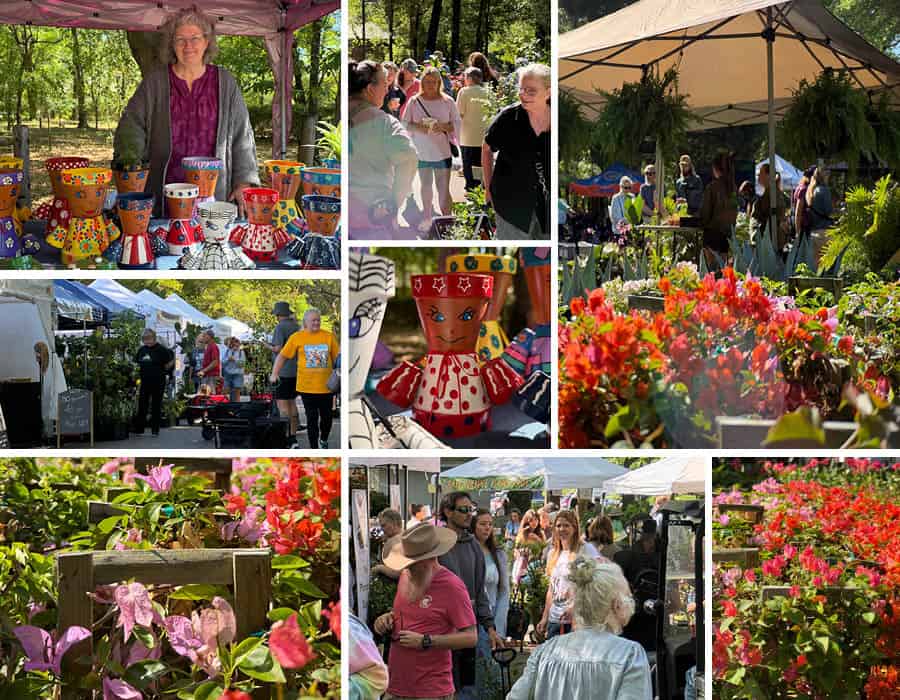
Although named “Festival of Flowers,” the event includes a lot more than just flowers. From the festival entrance, surrounding the many visitors as they pulled their wagons behind, is a sea of plants – saplings of many kinds – and vendors of many crafts and baked goods.
“We do try to make sure that it’s [products in the festival] something that is local to the community, and something that is handcrafted.”
Dallas also shared their insistence on keeping bigger organizations and retailers from coming to the festival to sell their merchandise. In her words, they “want to keep it as local as possible.”
One of these local vendors is Laura Harrison, a longtime festival visitor who is now a vendor. Laura sold her own hand-painted pots, which boasted vibrant colors and fun designs. Her “Painted Lady Pots,” as she called them, were eye-catching, and visitors, like me, passing by could not help but take a look.
Aside from the colors, the pots themselves have unique designs. The Lady Pots were painted to look like women wearing traditional clothing, with smaller pots attached on the side to look like dress sleeves. All in all, the pots are not just beautiful but also fun. With the way the pots are painted, when a plant is in the pot it looks like hair, which completes the whole “lady” look.
Laura also sells some turtle-shaped pots, with a tic-tac-toe layout and some stones to play the game at the back, where the shell would be, and a small pot, perfect for a small succulent, painted to look like the turtle’s head; one of which was sold to a very amused and fascinated guest as I was taking photos of Laura’s stall.
Her hand-painted pots were the result of a hobby she started to relieve stress from her job. The idea came from a post she saw on Pinterest, which she thought to give a try, and led to her selling the pots that had since piled up from her hobby.
The most interesting and fun aspect of Laura’s story is the reason she chose to hand-paint pots, and it is largely related to the festival: “We show up here, and I would buy plants, and then it was, ‘where do I put them?’”
“Now I have pots, and I either need more plants or unload the pots; so we’re gonna sell the pots!”
However, while plants and the local community take the spotlight on the surface, the festival has a bigger significance than just having fun and giving a venue for local vendors and plant enthusiasts to gather.
“The whole core of everything that is going on here is to support the educational programs that we have here… we do natural research conservation, and plant science… so that’s kind of like the origin of this event.”
The festival’s advocacy for environmental pursuits can be seen with many of the booths set up. Organizations like the Florida Fish and Wildlife Conservation (FWC) participated in the event, which set up a booth at the festival that showcased different forest finds, with their representatives sharing information and their experiences related to Florida’s wildlife.
Many vendors also sold native plants, doing so while teaching visitors about Florida’s natural plant ecosystem. Dallas stated that Florida’s growing concerns about invasive plant species “is something that has become hugely more important in recent years and garnered a lot of attention.”
Information from a report by the FCW states that the state’s concerns over invasive plant species dated back to the late 1800’s, when South American floating hyacinths were introduced to the St. John’s River. Currently, data from the same report states that approximately 1.5 million acres in the state of Florida are impacted by nonnative invasive plant species.
The issue has become a widespread concern. Many neighborhoods and areas are making a positive change by having policies that only allow native plants in the yards. That “ecological mindset,” said Dallas, is what the event is trying to encourage.
“You can’t plant exotics or certainly not any invasive… that way, the natural heritage stays that way. And so that’s kind of like the big main drive of this whole event.”
Growing every year, the event delivered a lot more than advertised. The festival was fun, in a very relaxing way, as visitors walked around, surrounded by various plants and the natural grove of the Milton Campus, with the nice spring weather following suit to create a perfect day that matched the environment-themed festival.
And more importantly, the event shed light on the important issues, raising awareness on what needs to be done; one florist, one gardener, and one plant enthusiast at a time.