
 By Riley Glover
Content note for discussions around war crimes and violence towards children
On February 6th, 2026, I watched the killing of a real child in an art cinema. Everyone walked out of the theatre, unable to communicate the atrocity beamed into them. Reactions were split depending on knowing the child’s story, leaving either in shock because of the end or, in the case of one person, crying for the entire last half of the film. We all saw a massacre, and we didn’t do anything to stop it.
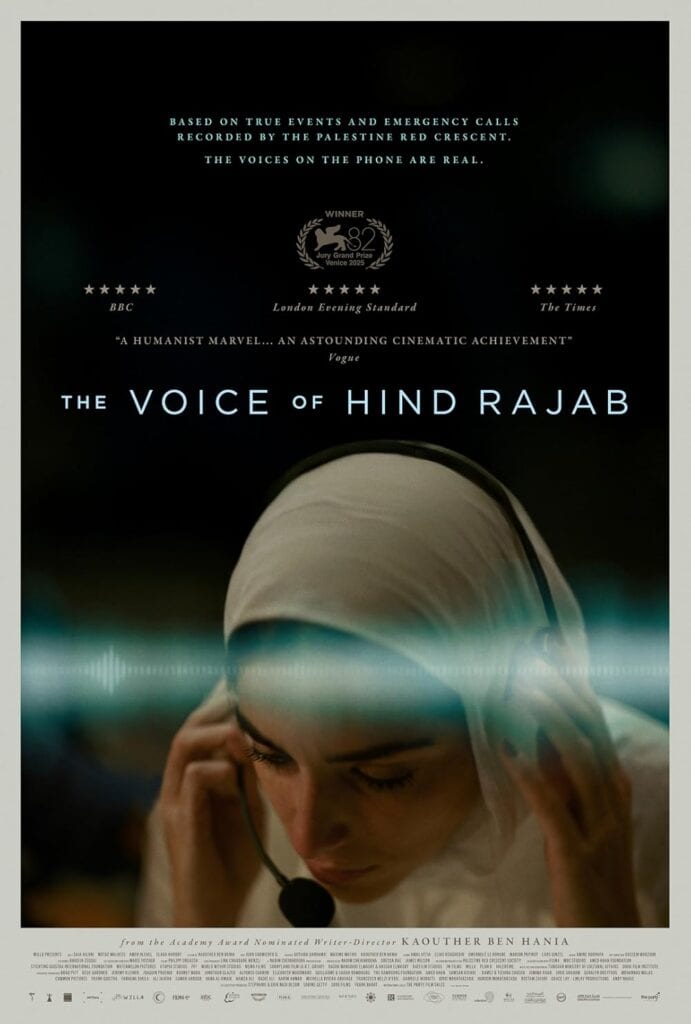
These were among my first thoughts after seeing “The Voice of Hind Rajab,” a docudrama creating a stir for the extremely provocative conceit surrounding its production: director Kaouther Ben Hania recreated the Palestine Red Crescent’s attempt to save the five-year-old Hind Rajab prior to her death on 29 January 2024, with actors playing the Red Crescent team, while having the actors still interact with the real phone audio of Hind.
Already, the subject matter is loaded. Rather horribly, Hind Rajab was killed after her aunt, uncle, and four cousins were likely killed by IDF forces, as implied by the guns used on their car and the tanks nearby, with Hind being forced to stay in the car with their dead bodies. The ambulance sent to help her by Red Crescent was later blown up near the car.
The incident sent shockwaves across the world; outside of the “Hind’s Hall” protests at Columbia University during 2024, this film is the third adaptation of the story on film after “Close Your Eyes Hind’ and “Hind Under Siege” last year. Nonetheless, the presence of previous works still makes this notable because this is the only one that runs at feature length, and it focuses only on the Red Crescent crew set on saving her than recreating the car itself. Despite the bravery in tackling this subject from this angle, I still have reservations if this approach is appropriate.
Kaouther directly confronts this queasiness head-on with the recurring theme of communication breakdown. Much of the conflict early on is the communication breakdown between Omar A. Alqam, who is among the phone operators who hears the screams, and Mahdi M. Aljamal, who is the one to organize though the bureaucratic nightmare blocking the ambulances into the war zone. From this conflict of ‘saving the children’ as concept and doing that though action becomes this recuring visual motif of the glass walls of the office becoming both the division bureaucracy has in saving lives, and a meta comment about the nature of dealing with atrocity entirely though the screen.
A line within the film nails the conflict when the Red Crescent are trying to get the audio out to the public, when Omar notes you can look on social media and see dead kids ripped apart on the streets; “Do you really think the voice of a terrified little girl will spark their empathy? She needs an ambulance.” This violence is happening and will continue to happen unless action is taken now.
But I told you what happened earlier. We see the collective get the green light and try to guide the ambulance though the streets only to get blown up. And the film shatters any protections from reality, and we just see the destroyed vehicles and Hind’s real mother frustration at her child’s death.
And the film ends with a large list of executive producers noted within the film industry like Jonathan Glazer, Spike Lee, Michael Moore, and Brad Pitt, whose name appears before the other mentioned. Because for me to take seriously a film “From Ground Zero” of the Gaza war and Palestinians, it’s not the thumbs up of film artists who have recognized the conflict publicly, but Brad Pitt.
From interviews, director/writer Kaouther Ben Hania is someone of tremendous character, both in wanting to make this girl’s voice heard though the Red Crescent’s actions, along with noting other contemporaneous films like “All That’s Left of You” and “Palestine 36” in interviews as helping to get Arab and Palestinian voices out there. While I believe in Kaouther’s need to give people like Omar A. Alqam, Mahdi M. Aljamal, Rana Hassan Faqih, and Nisreen Jeries Qawas of the Red Crescent, and Hind Rajab’s family a voice showcasing the work that was put in to save this girl without fetishizing pain, the contrast of real and recreated distance makes me imagine the audience who would see this in the art cinema circuit most able to play it; a pitying, guilty middle-class western audience who will consume this as a ‘serious issue’ film, and then just move on like they didn’t hear a real machine gun death within the opening. This was the past, not what continues to happen present and tomorrow, “Here and Elsewhere,” if nothing is done to stop it.
To reference Nadia Yaqub’s introduction for “Gaza on Film” on when Palestinian art gets circulated after tragedy, I felt not that I watched a film that was to “invite others to deepen their ties to a community of conscience,” but was there to feel this death was a sign of defeat for now memorializing the past, rather than a call for making Isreal accountable for their actions now for a better tomorrow. While I am still a westerner essentially venting my guilt in not doing more and possibly speaking over Arab writers doing the work, I still don’t feel this is a major “Introduction to the End of an Argument” that says Palestinians deserve self-determination, only a compromise for a multi-generational tragedy the western world is deeply complicit in.
That feeling has never shaken away from me ever since I watched the film. Nobody talked about our unsettled feelings, despite the film clearly wanting us to speak. If the respectable, euro-centric art house theatre can be the only place for serious political film to be seen for it then only just be consumed than communicated with, western film consumption is a meaningless, navel gazing, and dehumanizing medium killing both filmmaking and political conversation. I think “The Voice of Hind Rajab” is an empathetic work of activist filmmaking worth discussion, but that alone won’t end a nearly 80 year long conflict the western world is complicit in nor will the context of distribution help in bringing it to the people who need it most. We need action now.