
by Quincy Kirn
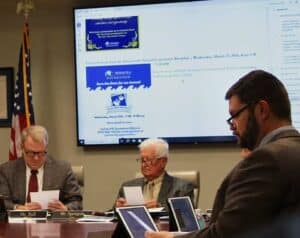
In recent years, the Pensacola State College District Board of Trustees have appeared frequently in mainstream media coverage, often in stories with concerns about transparency, governance structure, intellectual freedoms, the right to protest, and student accessibility. The Corsair sat down with Chair Gordon “Flash” Sprague to learn what the role of the Board of Trustees actually is and how they impact our college.
Throughout the interview, Chair Sprague characterized the Board as a collective governing body. The Chair explained that individual trustees possess no independent authority; the Board only acts as a unit. According to Chair Sprague, that structure is intended to ensure adherence to established governance practices.
When Pensacola State College’s District Board of Trustees meets, decisions often appear swift and unified. Public debates during these meetings are limited; agenda items move quickly, and votes are frequently unanimous.
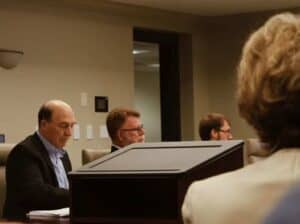
According to Chair Sprague, that appearance is largely the result of work that is done before the public enters the room. Trustees meet in committees ahead of the scheduled Board meetings, where agenda items are discussed, and members are briefed over thirty-minute workshops. By the time an item reaches the full Board, Trustees are already informed even if those discussions did not take place publicly. He emphasized that committee meetings allow Trustees to receive information so board meetings can function efficiently and clarified that this process is consistent with the Board’s role as a policy-making body and that it complies with public notice requirements.
Chair Sprague clarified that, under normal circumstances, proposed policy revisions are introduced first as information items and then brought back for a vote at subsequent meetings, typically about thirty days after. This timeline allows public notice and review before final action is taken. He also acknowledged that the Board has the authority to act more swiftly when circumstances require immediate attention. In February, the Board convened with the Charter Academy to approve an item that required immediate review. Trustees were informed that a biology instructor at the Charter Academy had been assigned to teach chemistry courses without holding the appropriate certification. As a result, the Board’s approval served as a necessity for the chemistry classes’ continuation. Chair Sprague did not specify criteria used to determine when expedition action is warranted.
Chair Sprague framed improvement in terms of policy maintenance and institutional support. He cited the Board’s responsibility to ensure that policies are in place to support students pursuing higher education and workforce training. Records from the Board’s February meeting show trustees approving new academic programs focused on workforce development and advancing policy updates described as administrative or technical. The actions reflected an emphasis on alignment with the state law and accreditation requirements.
In recent years, questions surrounding student speech and intellectual freedom have taken on increased visibility across Florida’s public colleges and universities. State law now requires public institutions to conduct annual intellectual freedom and viewpoint diversity surveys, reflecting on-going debate about how campus policies intersect with First Amendment protections. News coverage throughout the state has also documented instances in which student protests have resulted in disciplinary review, including reporting by WGCU on pro- Palestinian demonstrations at University of Florida, where students were warned they could face suspension or temporary campus expulsion. Such cases have contributed to broader discussions about how public institutions interpret and enforce speech-related policies. At public colleges, the First Amendment protects a broad range of expressive activities, including student journalism, peaceful protest, and the expression of views. Those protections operate alongside institutional policies that set parameters for expressive activity.
Pensacola State College has also previously appeared in national discussions related to campus speech policy. In 2014, the college became the subject of a legal dispute after faculty members were directed to route media inquiries, including requests from student journalists, through the administration rather than speaking independently. The directive, issued under President Meadows, prompted objections from student journalists and drew involvement from outside free speech organizations, which argued that the policy raised First Amendment concerns. The case is part of the College’s institutional record and provides context for ongoing discussions about governance and free expression. When asked how the Board currently approaches students’ First Amendment rights, Chair Sprague stated, “the Board and the college adhere to all applicable federal and state laws.” He noted that freedom of expression is constitutionally protected, and that campus demonstrations are subject to established rules and procedures, which are administered by campus law enforcement. Financial backing of The Corsair is another way the Board of Trustees contributes to sustaining First Amendment expression on campus.
Beyond affirming First Amendment protections, the Board also points to formal channels where students can raise ideas or concerns about campus policies and institutional decisions. Chair Sprague noted that students may submit suggestions or requests for change through existing policy mechanisms, like petitions. That avenue is separate from the public comment portion of the Board meetings.
The governance model centered around collective decision-making and procedure has enabled the Board to act efficiently while maintaining a consistency. As discussions regarding free expression on campus continue, the structure described by the Board provides a better understanding of how decisions are made and how concerns are formally addressed. For students and community members seeking engagement, understanding the framework of the institution may be as critical as the outcomes it produces. If you would like to attend one of the Board meetings, they typically hold public committees on the first Tuesday, after the third Monday of each month, officially beginning at 5:30 pm. The Board also recently began live streaming the meetings via Zoom; Check the Pensacola State College website for the Zoom link, list of dates, and campus locations of any future meetings.